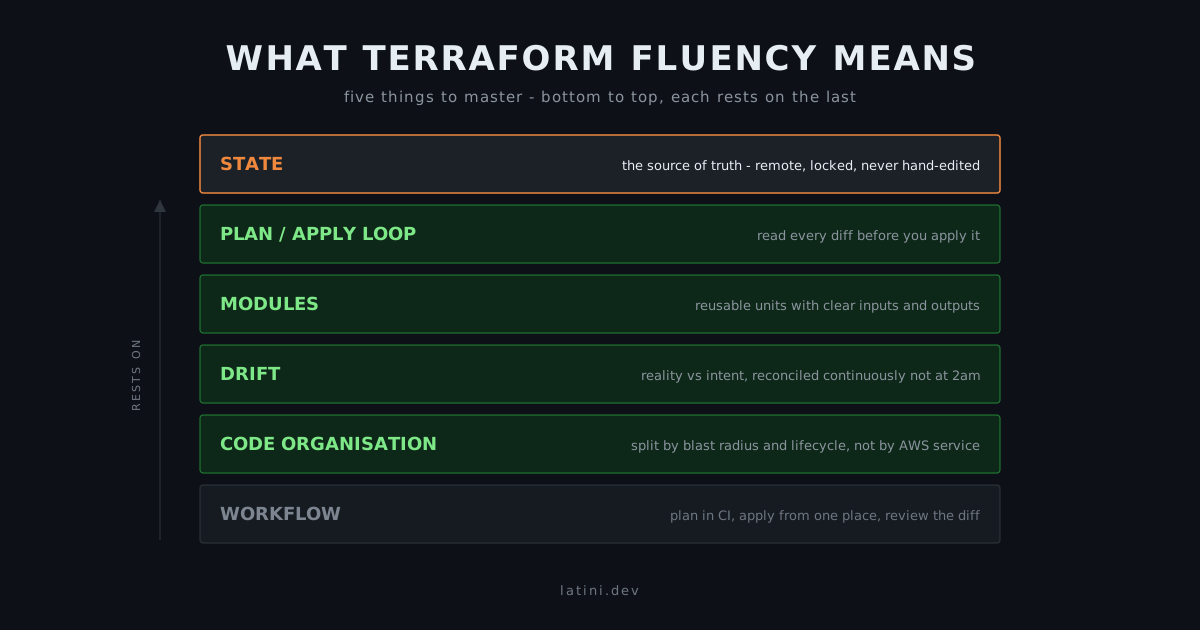
TL;DR - Most people who “know Terraform” have memorised plan and apply and treat the rest as weather. Fluency is a mental model, not a command list. Internalise five things - state as the source of truth, the plan as a diff you actually read, modules as functions, drift as a signal, and code organised by blast radius - and Terraform stops being a slot machine you pull and start being a tool you steer. This is the post I wish someone had handed me before my first terraform destroy on the wrong workspace.
When I tell people moving into platform work where to start, my first answer is always the same: learn Terraform fluently. Not “learn Terraform.” Fluently. The gap between the two is enormous, and it’s where most of the production incidents I get called about actually live.
Here is the tell. Someone who has memorised Terraform runs apply, watches it churn, and feels a small spike of adrenaline every time, because they don’t fully know what it’s about to do. Someone who is fluent reads the plan output like a code diff, knows exactly which resources will change and why, and finds apply boring. Boring is the goal. Boring is what fluency buys you.
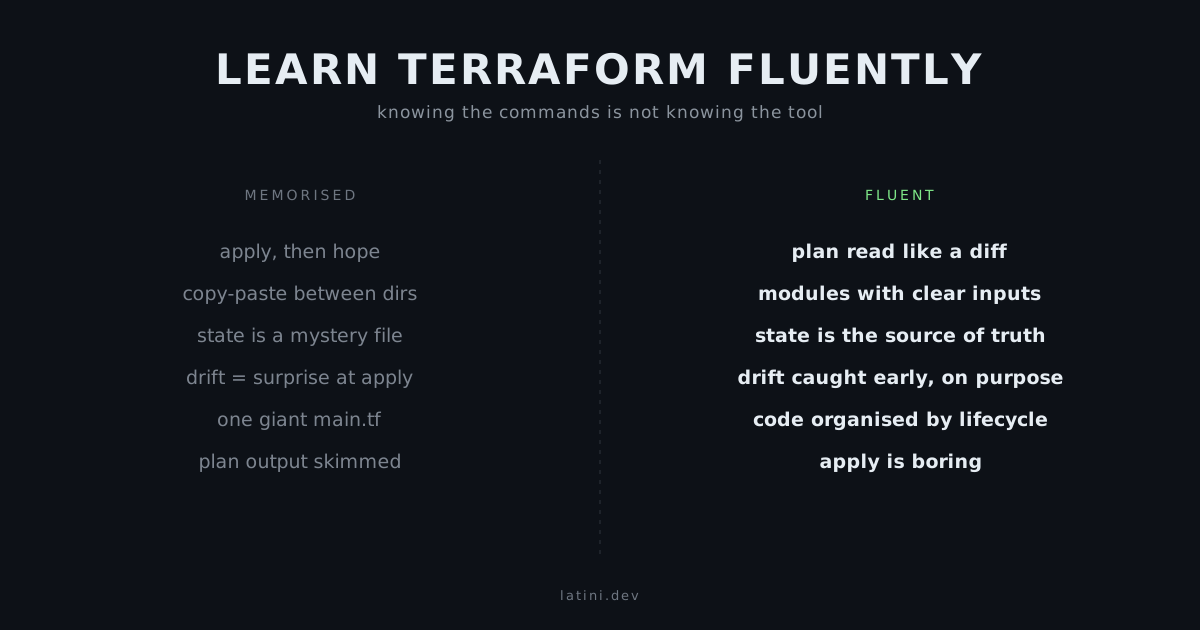
This is not a syntax tutorial. The documentation is good and the AI autocomplete is better. This is about the model in your head, because that’s the part the tooling can’t give you. Five things make the difference.
State is the whole game
If you understand exactly one thing about Terraform, make it state.
Terraform is not a tool that creates infrastructure. It is a tool that reconciles three pictures of the world: the configuration you wrote (intent), the state file (what Terraform believes it already created), and the real provider (what actually exists). Every plan is a three-way diff across those pictures. Every confusing Terraform behaviour you have ever hit - “why is it trying to destroy this?”, “why does it think this already exists?”, “why is it doing nothing when I clearly changed something?” - is a disagreement between those three.
Once you hold that model, the rules stop being arbitrary:
- State is the source of truth, and it lives remotely. Local state on your laptop is a single point of failure with a side of merge conflicts. Remote state in S3, GCS, Terraform Cloud, or an equivalent, with locking turned on, is non-negotiable the moment more than one person - or one CI job - touches the infrastructure.
- You never hand-edit state. When state and reality disagree, you reconcile with intent, not a text editor.
terraform importto bring an existing resource under management.terraform state mvwhen you rename or refactor and don’t want a destroy-and-recreate.terraform state rmto forget a resource without destroying it. These three commands are the difference between fixing state surgically and nuking a production database because Terraform wanted to “replace” it. - State is sensitive. It contains the values of everything, including secrets, in plaintext. Treat the state backend like the crown jewels, because it is.
Most Terraform disasters are state disasters wearing a different hat. Get this layer right and the rest of the tool becomes legible.
The plan is a conversation, not a formality
terraform plan is the single most underused safety feature in infrastructure-as-code. People run it, see a wall of green and yellow, scroll to “Plan: 4 to add, 1 to change, 0 to destroy”, and type yes.
Fluency is reading the actual diff. Specifically, three things will save your weekend:
- Watch the verbs.
+create and~update in place are usually fine.-/+means destroy and recreate, and that is where the outages live. A-/+on a stateless compute instance is a shrug. A-/+on a database, a load balancer, or anything holding data is a five-alarm signal that you need to understand why before you proceed. Terraform tells you the reason - “forces replacement” - right next to the attribute that triggered it. Read it. - Plan against the right target. The number of incidents that begin with “I thought I was in the staging workspace” is not small. Fluency means the workspace, the variable file, and the backend are things you verify, not assume.
- Save the plan, apply the plan.
terraform plan -out=tfplanthenterraform apply tfplanapplies exactly what you reviewed, not whatever the world looks like thirty seconds later. In CI this isn’t optional, it’s the entire point.
The plan is Terraform showing you its homework before it acts. The fluent engineer treats every plan as a code review where the author is a robot that will do precisely, and only, what it said.
Modules are functions, not folders
The day Terraform clicks is the day you stop thinking of modules as “folders I put .tf files in” and start thinking of them as functions: they take typed inputs (variables), they have a body (resources), and they return outputs. A good module hides a pile of provider detail behind a small, meaningful interface, exactly the way a function hides an algorithm behind a signature.
This is the same idea as a golden path, one layer down. A developer who consumes your service module shouldn’t be writing VPC and IAM and security-group resources by hand any more than they should be hand-rolling a CI pipeline. They call the module, pass a name and a few knobs, and get a correctly-built thing. The module is the paved road for infrastructure.
The trap, and I have fallen in it, is over-modularising. Signs you’ve gone too far:
- A module that wraps a single resource and passes through every one of its arguments. That’s not abstraction, it’s a layer of indirection with a tax. Use the resource directly.
- Inputs that exist only to be threaded through to some deeply nested module. Every
variableblock you add is part of a contract you now have to maintain. - “DRY” applied so aggressively that nobody can tell what a module actually creates without reading four files.
The honest rule: extract a module when you have the same cluster of resources, configured the same way, in three or more places, and the grouping means something to a human. “Our standard service” is a meaningful boundary. “Three resources that happen to appear together” is not. Premature module-building is just complexity tax paid in HCL.
Drift is a signal, not an annoyance
Drift is when reality and your code disagree: someone clicked something in the console, an autoscaler changed a count, a different pipeline edited a resource Terraform thinks it owns. Beginners discover drift the worst possible way - in the middle of an unrelated apply that suddenly wants to revert a change they didn’t make.
Fluency is treating drift as information you collect on purpose, before it ambushes you:
- Detect it continuously. A scheduled
terraform plan(in CI, with no apply) that exits non-zero on any diff turns drift from a surprise into an alert. You find out a human touched production by hand within the hour, not three weeks later during a deploy. - Decide who owns each resource. Some drift is sabotage and some is legitimate - a value Terraform genuinely should not manage. For the legitimate cases,
ignore_changesin alifecycleblock, or simply not putting that attribute under Terraform’s control, is the fluent answer. Fighting an autoscaler withapplyis a war you will lose nightly. - Close the console. The single biggest source of drift is people making “quick” manual changes. The cure is cultural, not technical: the paved road has to be easier than the console, or the console wins.
If this sounds familiar, it’s the same structural problem as the gap between intent and reality I wrote about in Your Staging Environment Is Lying To You. Drift is that gap for your infrastructure, and the fix is the same family of move: detect the divergence early, with real signals, instead of trusting that the picture in your head matches the picture in production.
Organise by blast radius, not by service
The most common Terraform layout in the wild is one enormous root configuration with all of production in a single state file. It works on day one and becomes a liability by month six, because every plan touches everything, every apply is high-stakes, and the state lock means only one change can be in flight at a time.
Fluent organisation splits state along the lines where the cost of being wrong changes:
- By blast radius. Networking, IAM, and data stores - the things that hurt most when they break and change least often - belong in their own state, applied carefully and rarely. Stateless application resources that change daily belong somewhere a routine apply can’t take down the VPC.
- By lifecycle and ownership. Resources that change together, and are owned by the same team, belong together. Resources on wildly different release cadences do not.
- Small enough to reason about. A state you can
planin under a minute and read in one screen is a state you’ll actually review. A forty-minute plan is a plan nobody reads, which means it’s a plan nobody is reviewing.
You wire these separated states together with outputs and data sources, or a tool like Terragrunt if the wiring itself gets repetitive. The point isn’t the tool. The point is that “what is the worst thing one careless apply could do?” should be a small, bounded answer, not “all of it.”
The workflow that makes it boring
Everything above lands in a workflow. The fluent setup is unglamorous and that’s the feature:
- Plan in CI on every pull request. The plan output goes in the PR. Infrastructure changes get reviewed as a diff, by a human, before anything happens. This is where reading the plan stops being a personal discipline and becomes a team guarantee.
- Apply from one place. Not from laptops. A CI job, Terraform Cloud, Atlantis, Spacelift - whatever you like, but one controlled path with locking, so two applies can’t race and nobody is steering production from a coffee shop.
- Pin everything. Provider versions, module versions, the Terraform version itself. Unpinned dependencies turn “it worked yesterday” into a debugging session. The lock file is your friend; commit it.
- Know that OpenTofu exists. After the licence change, OpenTofu is a drop-in, open-source fork that a lot of teams have moved to. For most work the two are interchangeable; it’s worth knowing the option is there, the same way I keep a boring, well-understood default for everything else.
None of this is exciting. All of it is what makes apply boring, and boring is what you want from the system that can delete your databases.
When to put Terraform down
Fluency includes knowing when the tool is the wrong tool, so here’s the honest off-ramp.
Terraform earns its complexity when you have real, long-lived infrastructure that more than one person manages and that you need to be able to rebuild, review, and reason about. Below that line, it can be ceremony:
- A single VM running a few systemd units. This is literally how I run inpedana.com, and there is no Terraform anywhere near it. A provisioning script and a documented rebuild beat a state backend for one box you could recreate from memory. That’s the boring stack applied to infrastructure: don’t buy the abstraction until the problem is bigger than the abstraction.
- A fully-managed PaaS. If your whole world is a Vercel project or a single Cloud Run service, the platform’s own config is often enough. You can always import into Terraform later, when “later” arrives.
- A genuine one-off you will never touch again. ClickOps in the console is a perfectly fine answer for a throwaway. The sin isn’t clicking; it’s clicking the thing you’ll have to recreate forty more times.
This is the same judgment I apply to Kubernetes: the abstraction has to be cheaper than the problem it’s hiding. For infrastructure that’s more than a couple of resources and meant to last, Terraform clears that bar easily. For a hobby box, it doesn’t. Fluency is knowing which side of the line you’re on before you write the first provider block.
The bottom line
“I know Terraform” usually means “I can run apply.” Fluency is the model underneath: state is three pictures Terraform reconciles, the plan is a diff you read rather than a gate you click through, modules are functions with contracts, drift is a signal you collect on purpose, and code is organised so the worst careless apply is a small, bounded mistake. Wrap it in a workflow that plans in CI and applies from one place, and the whole thing becomes boring - which, for the tool that owns your production infrastructure, is the highest compliment available.
Get fluent in this order - state first, always - and Terraform stops being the scary part of platform work and becomes the foundation the rest of it stands on. That’s why it’s the first step I recommend to anyone serious about the discipline.
If you’re staring at a Terraform codebase nobody fully understands, or a state file everyone’s afraid to touch, let’s talk.