Every team I have ever worked with has a staging environment. Every team I have ever worked with also has a story about the thing that worked in staging and broke in production. Usually told in the postmortem. Usually with a slide titled “How did we miss this?”
We didn’t miss it. Staging missed it. That is the job staging cannot do, and pretending otherwise is the most expensive habit in modern infrastructure.
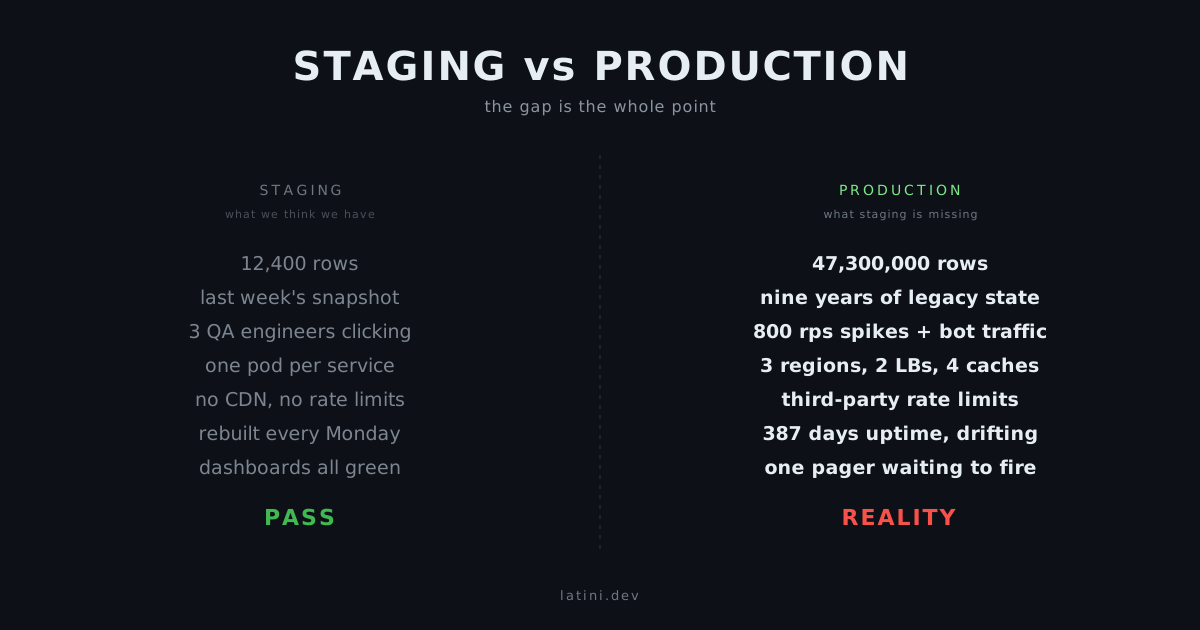
This post is about what staging is actually for, why it drifts from production no matter how hard you fight it, and the production-safety habits that quietly pay off ten times more than another month of “staging parity” work ever will.
The staging promise vs. the staging reality
The promise is simple: a faithful copy of production where we catch problems before users do.
The reality has four problems, and they stack.
Different data. Staging databases are either anonymised snapshots from weeks ago, synthetic data with neat distributions, or just empty. None of those have the cardinality, the long-tail values, or the legacy rows that production has been accumulating since 2017. The query that times out on the row created during a botched migration in 2019 cannot time out in staging, because that row does not exist in staging.
Different traffic. Staging gets internal traffic: QA, devs clicking around, a couple of cron jobs. Production gets the actual workload: bursty, concurrent, with hot keys and pathological clients. The bug that only appears at 800 requests per second on a single endpoint is invisible in a tool that sees 8.
Different topology. Staging has one of everything. Production has three of one thing, a load balancer in front of two regions, a CDN with stale cache behaviour, and a third-party API that rate-limits per source IP. The interesting failures live in the seams between those, and the seams are not in staging.
Different time. Production has been running for years. Its file systems have history. Its connection pools have been exhausted and recovered. Its queues have backed up and drained. Staging gets rebuilt every sprint. The bugs that emerge from cumulative state are bugs staging will never see.
You can attack any one of these. You can replicate prod data nightly (and now you have a GDPR conversation). You can shadow-mirror traffic (and now you have a cost conversation). You can mirror topology (and now you have a budget conversation). Each attack costs more than the last and closes only part of the gap. The gap never gets to zero. The gap is the whole point.
What staging is actually good for
Staging is not useless. It is just not what most teams claim it is.
Staging is good for:
- Deployment mechanics. Does the artifact build, ship, start, pass its health check, run its migrations without exploding? If your CD pipeline can’t roll out to staging cleanly, it has no business going near production.
- Integration smoke tests. A handful of end-to-end happy paths that exercise the boundaries between your services. Not a full test suite. A heartbeat.
- Manual exploration of new features. Designers, PMs, and stakeholders need somewhere to click around before launch. Staging is fine for that.
- Schema and migration validation. Does the migration apply against a database with real-ish row counts without locking for an hour?
Staging is not good for:
- Catching performance regressions. Different data, different traffic, different topology. You will not catch them here.
- Finding race conditions. The concurrency profile is wrong by an order of magnitude.
- Reproducing production bugs. By the time you have built the staging dataset that reproduces it, the bug is fixed or the user has churned.
- Replacing observability in production. The number of incidents I have seen where the runbook says “first, see if you can reproduce it in staging” is depressing. By the time you have reproduced it, the incident is over.
The mistake is not having a staging environment. The mistake is letting “we’ll catch it in staging” be the answer to “how do we keep production safe?” It is not the answer. It is barely an answer to a different, smaller question.
Where the actual safety lives
If staging cannot catch the interesting failures, what does?
The answer is the production-safety stack. Five practices, ordered roughly by leverage. None of them are new. All of them are routinely skipped because teams trust staging too much. And in a mature org none of them are things each team reinvents alone: feature flags, canaries, and reversible deploys belong in the paved road that platform engineering ships once and everyone inherits.
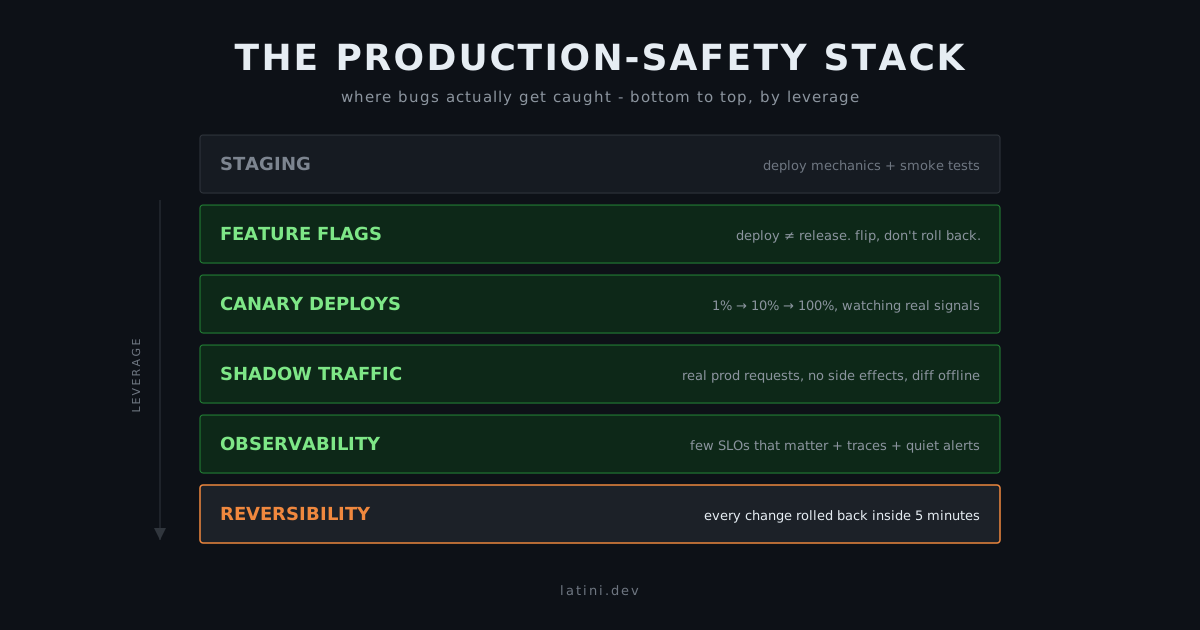
1. Feature flags by default
Every non-trivial change ships behind a flag. The deploy and the release are separate events.
This is the single largest reduction in “staging missed it” incidents I have ever seen, and it costs almost nothing to set up. A flag service, a wrapping function, a discipline. The first week is a small tax. After that it is invisible.
What it buys you: when the new code behaves badly in production - and the operative word is when - you flip the flag, not the deployment. You debug at your leisure. You don’t roll back five other changes that happened to be in the same release.
2. Canary deployments
The new version goes to 1% of traffic first. Then 10%. Then 100%. Each step waits long enough to see the metrics that matter.
Canary deploys are how you let production be its own test environment, safely. The first 1% is the most honest staging you will ever have. It uses real data, real traffic patterns, real topology, real time. If your canary alerts on error rate or latency, you stop before the blast radius exceeds the canary.
The trick is the wait. A canary that runs for 30 seconds is a deploy with extra steps. A canary that runs for 30 minutes, watching real signals, is a different kind of guarantee.
3. Shadow traffic
For high-risk changes (a query rewrite, a new ranking algorithm, a different storage backend) you mirror production traffic to the new code path without using its results. You compare outputs offline.
This is the closest thing to “test in prod safely” that exists. The hard parts: filtering side effects (do not double-charge the user), keeping the shadow path cheap enough not to add load, building the diff machinery. The payoff is enormous for the changes where it applies. Not every change deserves it. The ones that do, deserve it absolutely.
4. Production observability you would actually wake up for
The argument for thick staging is “we want to know if it breaks before users do.” The argument for thick observability is the same, except it works.
Three things you need, none optional:
- A handful of SLOs that map to actual user pain. Not 40 SLOs. Two or three per critical service. If they fire, someone is having a bad time.
- High-cardinality traces. When something goes wrong, you need to ask questions the dashboard authors did not anticipate. That is what distributed tracing is for. Static dashboards will not save you.
- Alerts that are quiet most of the time and loud when they aren’t. Alert fatigue is how production goes down with a green dashboard. If your team has muted the channel, the channel is broken.
I have written about this in more depth in Are You Really Monitoring Your Infrastructure? - the short version is that “we have dashboards” and “we have observability” are not the same sentence.
5. Reversibility above all
Every change is a deploy you can roll back, a flag you can flip, a migration you can reverse, a feature you can hide. The system is structured to assume you will be wrong, often, in ways nobody anticipated.
A team that can roll back any change inside five minutes will outperform a team with twice the staging fidelity and irreversible deploys. The cost of being wrong is what matters. Reversibility is the variable you actually control.
The pragmatic staging
Once you stop asking staging to be production, what should it actually look like?
In my experience, the answer is much smaller than what most teams build. Some version of:
- One environment, not three. (No “QA” and “staging” and “pre-prod.” Pick one.)
- Same shape as production, fraction of the scale. One pod per service instead of ten. One region instead of three. One database, not the HA cluster.
- A small, curated dataset that exercises the interesting edge cases you have learned about over time. Not a production clone. A surgical fixture.
- Rebuilt from scratch reliably and often. If you can’t tear it down and bring it up in under an hour, it’s a pet.
- Routed traffic from the deploy pipeline only. No external dependencies in critical paths.
The boring stack version of this, for a small team, can literally be a second VM running the same systemd units against a copy of last night’s SQLite file. I have used this on inpedana.com for exactly the things staging is good for: making sure the deploy works, the migrations run, the new feature renders. It catches nothing the canary wouldn’t have caught. That is fine. That is its job.
When the boring answer is wrong
There is one shape of system where staging needs to be much more than this: regulated environments where you cannot test in production at any granularity. Healthcare, payments, defense. The “canary on 1% of users” answer is a non-starter when 1% of users is still a million dollars of risk per minute.
Those teams pay an enormous staging tax knowingly. The tax is real and so is the reason. If that is your industry, I am not telling you to dismantle staging. I am telling you to be honest about what it costs and what it covers.
For everyone else - the overwhelming majority of teams shipping SaaS, internal tools, marketing sites, content products, B2B dashboards - the math is the other way around. You are paying for a staging environment that catches a small fraction of the bugs you fear, while underspending on the practices that would catch the rest.
The honest summary
Staging is a deployment safety harness. It is not a bug detector. The bugs you fear most live in the gap between staging and production, and the gap is structural, not a budget problem.
If you have a staging environment that costs more than 10% of your production environment and catches less than 10% of your production bugs, you are running theatre. The fix is not a thicker staging. The fix is feature flags, canaries, shadow traffic where it earns its keep, the observability you have been promising the team for two quarters, and a deploy story that is reversible by default.
That is the boring version. It is also the version that lets you sleep at night.
If your team is paying a staging tax that doesn’t add up - or you have no idea what your production-safety stack actually catches - let’s talk.