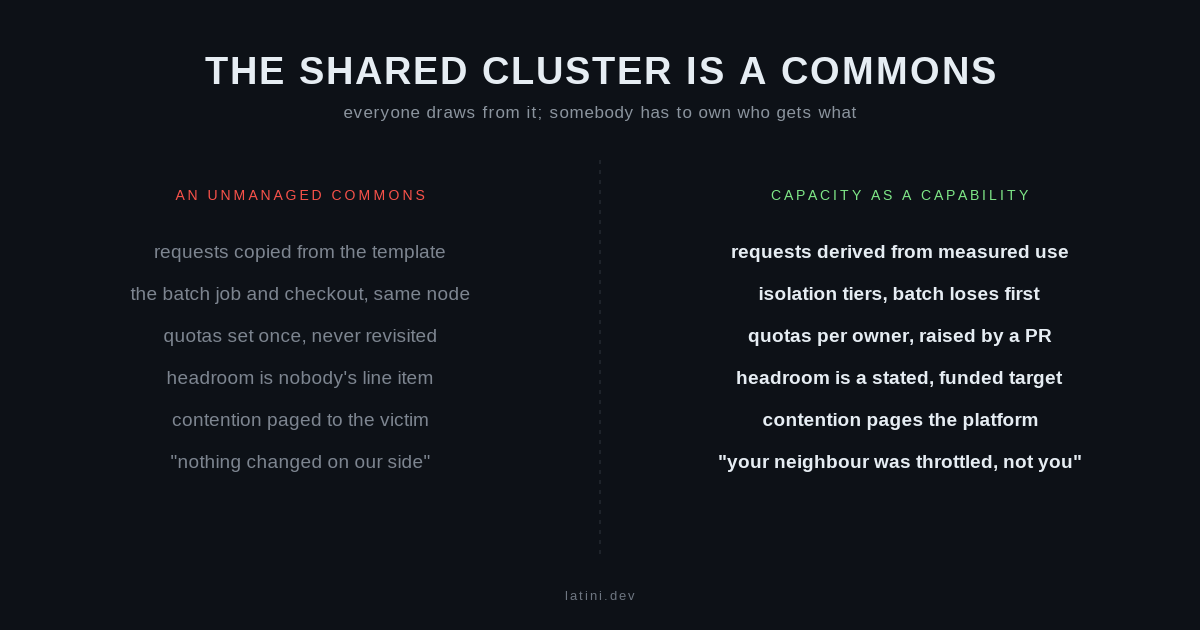
TL;DR - Every shared platform is a commons: forty teams drawing CPU, memory, disk, connections and API calls from the same pool. Most platform teams run that commons without anyone owning who gets what. Resource requests are copied from the template on day one and never touched again, quotas are set once and forgotten, headroom is nobody’s line item, and when one team’s batch job starves another team’s checkout service, the incident lands on the victim’s pager with the words “nothing changed on our side”. That is not bad luck and it is not the victim’s bug. It is a missing platform capability. The cure is not a cluster per team. It is requests derived from measured use, isolation tiers where the batch job loses first by design, quotas attached to owners and raised by a pull request, headroom as a stated and funded target, and contention signals that page the team that owns the substrate.
I build and run platforms for a living, and one of the most demoralising incidents I know has a very specific shape. A product team’s latency doubles at 2am. They check their deploys, their flags, their config, their dependencies. Nothing changed. After an hour someone notices that their pods share nodes with a reporting job another team moved to nightly last week, and that the job has been eating every spare core on those nodes for forty minutes a night.
The post-incident review then asks a sensible question: who was supposed to stop that? And the room goes quiet, because the honest answer is nobody. The product team did nothing wrong. The reporting team used capacity that was, as far as the cluster was concerned, available. The platform team provided the cluster and never said what sharing it meant.
The tell
Three questions, asked of the platform team rather than of any product team:
- How far apart are requested and used resources, per team? If nobody knows, the scheduler is making placement decisions from numbers that were guessed once and never checked. If somebody knows and the gap is three to one, the cluster is being planned around fiction.
- When two workloads want the same node at the same time, which one loses? If the answer is “whichever one the kernel picks”, you have no policy. You have a coin toss with your most important service on one side of it.
- Who decides when the platform needs more capacity, and what is the target headroom? If the answer is “the autoscaler”, ask what happens when the autoscaler hits an account limit, an instance type that is out of stock, or a subnet that has run out of IP addresses. Somebody finds out during the incident.
If those answers are vague, the commons is being grazed on trust.
Why shared capacity becomes a commons nobody runs
None of this is deliberate. It happens for reasons that each sound reasonable.
- Requests are guesses that nobody revisits. The template ships with a default of half a core and a gigabyte, the first team copies it, and every team after them copies the first team. Some services need a tenth of that and some need four times as much. The scheduler believes all of them.
- Overcommit hides the guess until contention exposes it. Most of the time, the sum of what everyone actually uses is well below what the nodes can deliver, so the wrong numbers never matter. They matter on the night two bursty workloads land on the same node, which is exactly the night nobody is looking.
- Limits get set as a reflex. CPU limits feel responsible, so teams add them, and then their latency-sensitive service gets throttled on a node that has idle cores. Memory limits get set below real peak usage, and the service is killed under load rather than slowed. Both look like application bugs.
- Quotas are set once, at onboarding. Someone picks a number for each namespace in the first month, and from then on a quota is either a wall a team hits during a launch or a number so large it means nothing.
- Headroom has no owner and no budget line. The cost conversation quite rightly pushes idle capacity down, and nobody pushes back, because nobody’s objective says “survive the loss of a zone during the evening peak”. Spare capacity is the first thing cut and the last thing anyone defends.
- Contention looks like the victim’s problem. Throttling, evictions, out-of-memory kills, slow disk and exhausted connection pools all surface as the victim’s latency and errors. The alert goes to the team whose service got slower, not to the team that owns the thing that made it slower.
That last point is the heart of it. The you build it, you run it contract only works if teams are paged for problems they can actually fix. A noisy neighbour is not one of them.
The neighbour is not only CPU
When people say “noisy neighbour” they usually mean CPU on a shared node. In practice the commons is much wider, and the worst incidents I have seen were in the parts nobody thought of as shared:
- Memory and node pressure. One workload’s leak triggers evictions of whatever the kubelet picks next.
- Disk and network bandwidth. A log-heavy job or a big image pull saturates a node’s disk or network, and everything else on it slows down.
- Connections to shared databases and caches. One service scales out to two hundred replicas, each with a pool of twenty connections, and the shared database runs out of connection slots for everyone.
- Shared internal APIs and rate limits. One team’s backfill hammers the identity service or a vendor API with an organisation-wide rate limit, and every other team gets throttled.
- Account-level limits. IP addresses in a subnet, load balancers per account, provider API quotas. These are commons too, and they run out without warning.
If your capacity model only covers CPU and memory on nodes, you have covered the part the scheduler already understands and left the rest to chance.
Make requests true by derivation, not by asking
The scheduler can only be as good as the numbers it is given. Asking every team to tune their requests by hand has never worked anywhere I have seen it tried, for the same reason nobody merges the dependency bot: it is the same small judgement, made a hundred times, by people with the least context.
- Start from the workload class, not one global default. The template for an HTTP service, a worker and a batch job should each ship with different starting requests. That is part of what a first golden path is for, and the reason the second and third paths need their own defaults rather than a copy of the first.
- Measure, then propose. Collect real usage per workload over a few weeks and generate a recommendation: the request near the sustained peak, not the average. Deliver it as one grouped change per repository, on a schedule, with the evidence in the description. The team approves or explains. Either way the number stops being a guess.
- Be deliberate about limits. For memory, set the request close to real usage and the limit at a level you would rather be killed at than exceed, because a memory overrun is not recoverable by slowing down. For CPU on latency-sensitive services, think hard before setting a limit at all: throttling on a node with idle cores is the most common self-inflicted noisy neighbour I see. Write the policy down per tier so it is not a per-team argument.
- Make the gap visible. Requested versus used, per team, on the same dashboard as their latency. A team that sees it has reserved four times what it uses will usually fix it. A team that never sees it never will.
Isolation is a set of tiers, not one setting
The answer to contention is not “isolate everything”. It is deciding, in advance, which workloads deserve which protection, and making the losers lose on purpose.
- Latency-critical. Customer-facing request paths. Requests close to real use, priority high enough that they are scheduled first and evicted last, and spread so that one node going bad does not take out every replica.
- Standard. Most internal services and workers. Shared nodes, honest requests, normal priority.
- Best-effort and batch. Reports, backfills, rebuilds, experiments. Low priority, allowed to use idle capacity, and the first thing preempted when something more important needs the room. That is not a punishment. It is the deal that makes cheap batch capacity possible.
- Dedicated. Workloads that are noisy by nature or need special hardware: large batch, GPUs, heavy stateful systems. Their own node pools, so their noise stays at home.
Each tier is a choice in the template, not a ticket to the platform team. A team picking “batch” should know what it gets and what it gives up, written in one paragraph. And the same thinking applies beyond nodes: per-tenant connection limits on shared databases, per-caller rate limits on shared internal APIs, separate pools for backfills. If you are still deciding whether a shared substrate is right for you at all, this is a large part of what the multi-tenancy case for Kubernetes actually costs once you are in it.
Quotas belong to owners, and move by pull request
A quota is the commons’ fence. It only works if it is attached to someone and can move as fast as the business does.
- One quota per owning team, generated, not hand-set. If you have an estate you can actually enumerate, the quota follows the owner record. When teams merge or split in a reorg, the quotas follow without a ticket.
- Raising a quota is a pull request with a fast answer. Small increases are approved automatically within the tier’s rules. Large ones get a short conversation about whether the capacity exists. A quota that takes a week to raise teaches teams to ask for far more than they need, which is how you get the fiction back.
- Quota usage is visible to the team. A team at 90% of its quota before a launch should find out from a dashboard in advance, not from pods stuck in pending on launch day.
Headroom is a budget, not an accident
The capacity you do not use is not waste until you know what it is for. Write the target down: for example, “lose one zone during the evening peak and still run every latency-critical workload, plus the largest known launch this quarter”. Then size to it, and defend it.
- State the target, then measure against it every week. Headroom below target is a platform risk with a number, not a vague feeling.
- Forecast, even roughly. Usage trend plus the launches you know about plus the batch jobs teams have announced. Once a month is enough. The goal is finding out about the subnet that runs out of addresses in March, in January.
- Autoscaling is not capacity planning. It is a mechanism inside a plan. Check the limits it can hit: account quotas, instance availability, IP space, the time it takes a new node to become useful. Each one is a cliff your autoscaler will drive off politely.
- Fund it as part of the platform. Headroom is a cost the platform carries on behalf of everyone. Show it explicitly next to the unit cost, so the next cost review cuts it as a decision rather than as a discovery.
Page the team that owns the substrate
Contention is a platform signal. Route it like one.
- Watch the commons directly. CPU throttling on latency-critical workloads, evictions and preemptions by tier, pods pending longer than a few minutes, node pressure, connection-slot saturation on shared databases, rate-limit rejections on shared APIs. These are the platform’s indicators, not the product team’s.
- Send them to the platform pager. The tiering I described for the platform team’s own on-call fits here directly: contention on latency-critical capacity is urgent, sustained pending pods for batch can wait until morning.
- Show neighbours on the “is it us?” dashboard. When a team’s latency spikes, the first panel should say what else was running on the same nodes and the same shared dependencies, and whether any of it was throttled, evicted or saturated. Most of the hour in my opening story was spent discovering that.
- Treat a contention incident as a platform incident. The fix is rarely in the victim’s code. It is a tier that was wrong, a request that was fiction, a quota that was missing, or headroom that had quietly gone.
Who owns what
- The platform owns the mechanism. Tiers and their defaults, priority classes, request recommendations, quota generation and the fast-raise path, headroom targets, the forecast, contention alerting and the neighbour view.
- Teams own the meaning. Which tier each workload belongs in, approving or explaining their request recommendations, announcing launches and big batch jobs before they happen.
- Whoever runs a shared dependency owns its fairness. If your team runs the database, the cache or the internal API thirty teams call, per-caller limits are part of your service, not a favour.
- Leadership owns the headroom target. How much spare capacity the organisation pays for is a business decision about risk. The platform team proposes it and makes the cost visible.
How you know it is working
- Requested-to-used ratio per team, falling towards something honest, such as under one and a half to one for standard workloads.
- Preemptions and evictions by tier. They should land almost entirely on batch and best-effort. Any on latency-critical workloads is a finding.
- CPU throttling on latency-critical workloads, close to zero.
- Time pods spend pending, at p90, by tier.
- Headroom against the stated target, every week, with the date of the last time it dipped below.
- Incidents caused by contention, counted from the incident review, and how long each took to identify the neighbour.
Notice what is not on the list: cluster utilisation as a headline. Chasing high utilisation is how you remove the slack that keeps neighbours quiet. Utilisation is a cost input, not a goal, and the cost metrics that matter are unit costs anyway.
When this is the wrong answer
- You are not running a shared substrate. If everything is on a managed serverless or container service, node-level contention is the vendor’s problem. The shared databases, internal APIs and account limits are still yours, so keep that part.
- You have a handful of services and one team. A boring stack on a few machines needs sensible limits and one person who notices. A tier model is ceremony at that size.
- Isolation is cheaper than coordination. If you have five large tenants and money is not the constraint, a cluster or account per tenant can be the honest answer. That is a build-vs-buy style decision about where to draw the line, and it is fine as long as you made it on purpose.
- Your load is wildly spiky and margins allow it. Sometimes the right answer is to overprovision generously and spend your effort elsewhere. Write that down as the headroom target, so it survives the next cost review.
- There is no road yet. If services still deploy by hand with whatever resources someone typed, start with the template. Tiers and recommendations need a place to live.
One guardrail for the other direction. The worst version of this is a platform team that treats every contention incident as a reason for another dedicated cluster, until there are thirty half-empty clusters, each with its own upgrade cycle and bill. Isolation has a price, and it is paid in money and in operational load forever. Use tiers and priorities first, dedicated capacity for workloads that are genuinely noisy, and a separate cluster only when you can say what it buys.
The bottom line
A shared platform is a commons, and commons do not manage themselves. Requests drift into fiction, limits cause the throttling they were meant to prevent, quotas freeze in their first month, headroom disappears in a cost review, and contention gets paged to whoever was standing closest to it. None of that is any one team’s fault, which is exactly why it has to be someone’s job.
So make it the platform’s job, on purpose. Derive requests from measured use. Define isolation tiers and make the batch job lose first. Attach quotas to owners and let them move by pull request. Write down a headroom target and fund it. Watch the commons directly and page the team that owns it. That is platform engineering doing what it promises: taking a problem every team suffers alone and solving it once, underneath them.
The question I would ask any platform team: in your last incident where “nothing changed on our side”, how long did it take to find the neighbour, and whose pager went off? If the answer is “an hour, and not ours”, that is the next capability to build.
If your shared clusters run on copied requests and good intentions, or your product teams keep getting paged for someone else’s batch job, that is exactly the kind of problem I help teams work through. Let’s talk.